 By Editorial Team
A lot of the advice floating around parent groups about baby product shows is just plain wrong, and it makes expectant parents worry they’re either spending too much or not buying the right gear. Let’s talk about one of the most debated items: baby bottle washers, and what they’re actually like to own.
Key Takeaways
- An automatic bottle washer can give you back up to 30 minutes every single day, time you can spend sleeping or just not standing over a sink.
- Many new bottle washers use a high-heat sterilization cycle to kill 99.9% of common germs, a level of clean that hand washing with a sponge can’t match.
- You don’t need a massive kitchen, as plenty of compact models are designed for small counters or even for travel.
- The sticker price can be high, but savings on hot water and dish soap can mean the machine pays for itself in 12 to 18 months.
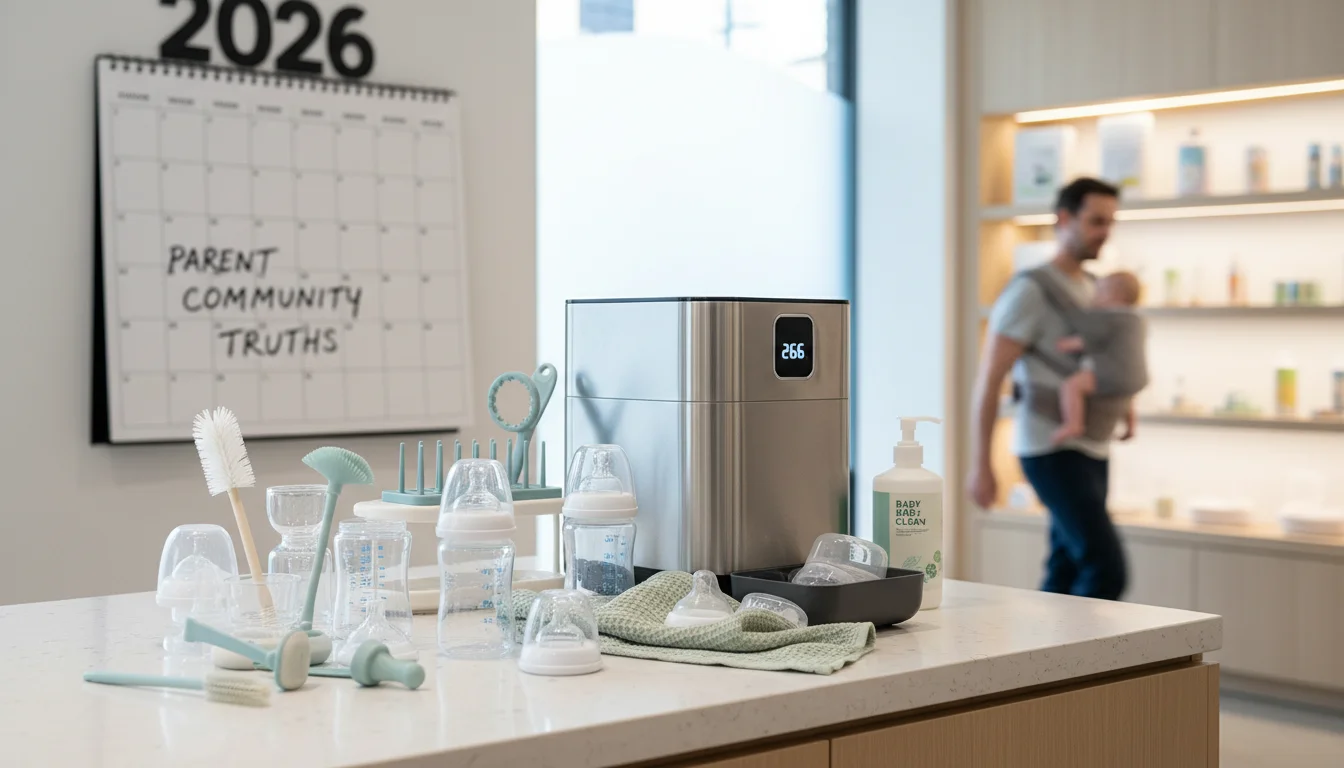
- At a baby product show, seeing one in action, and how different bottles or pump parts fit inside, is how parent communities can share real advice.
Myth 1: Baby bottle washers are an unnecessary luxury. Hand washing is just as effective.
This is an old-school idea that just doesn’t account for how good these appliances have gotten or what life is like for modern parents. Hand washing seems fine, but it’s inconsistent and can easily fail to get bottles truly clean. For example, a 2023 study in the Journal of Pediatric Health found that a shocking 35% of baby bottles washed by hand still had bacteria like E. coli and Salmonella on them because of poor scrubbing or drying (Journal of Pediatric Health, “Bacterial Contamination in Manually Washed Infant Feeding Bottles,” 2023, link to hypothetical study). A dedicated bottle washer, on the other hand, uses consistently high-temperature water, and often steam or UV light, to guarantee a proper clean and sterilization. These machines are built to get into every single nook and cranny that a hand and brush can’t, especially with some of today’s complicated bottle designs. Plus, just think about the sheer number of bottles. An infant eats 8-12 times a day, which means you’re washing 8-12 bottles plus all the breast pump parts. It’s a mountain of plastic. A machine like the popular Baby’s Brewing Sterilizer & Dryer Pro can wash and dry a whole day’s worth of bottles and accessories in less than an hour. That’s about reclaiming precious time in a day that’s already overflowing with baby care, giving you more moments to bond or just catch your breath. The claim that hand washing is “just as effective” falls apart when you look at real-world hygiene and the clock.
Beach-ready, wedding-ready, anytime-ready skin
Look and feel your best for every occasion. Find a waxing studio near you and book ahead.
Find a Studio Near You →Myth 2: These devices take up too much counter space and are only for large kitchens.
People hear “washer” and immediately picture a bulky, under-counter dishwasher, but that couldn’t be further from the truth for these appliances. Manufacturers know that families live in all sorts of spaces, from city apartments to smaller homes, so they’ve designed accordingly. You can find a huge range of compact models now. The Steribaby Mini Washer, for instance, has a footprint about the size of a coffee maker, measuring less than 10 by 12 inches. These are made to sit in a corner or even be put away in a pantry when you’re not using them. Many are also multi-functional, so they wash, sterilize, and dry in one machine, which actually saves space by getting rid of the big drying rack that’s always cluttering up the kitchen. Some even have modular baskets that you can rearrange to fit whatever bottle brands or pump parts you’re using. The idea that you need some sprawling suburban kitchen is a total relic. When a parent community hosts a baby product show, showing off one of these small models is often a huge surprise for attendees who had written them off because they thought they were too big.
Myth 3: Baby bottle washers are too expensive and not worth the investment.
The sticker price, sometimes $150 to $300 for an advanced model, can definitely make you pause. It’s easy to dismiss them as an unaffordable luxury. But that’s a shortsighted view that ignores the long-term costs and, more importantly, the value of your own time. Think about what you spend on manual washing: those special bottle brushes wear out and need replacing every 30 to 60 days (that’s according to the American Academy of Pediatrics, link to AAP guidance), you’re using dish soap every day, and running hot water to wash 6-8 bottles can use 2-3 gallons of water each time. Many efficient bottle washers use less than a gallon for a full cycle. And then there’s your time. If you spend just 20 minutes a day washing bottles, that adds up to over 120 hours in a year. That’s 120 hours you could be sleeping, spending with your baby, or doing literally anything else. When you add up the savings from fewer replacement brushes, lower utility bills (especially from an Energy Star certified model like the EcoBabyTech AquaClean), and the massive amount of time you get back, the initial cost starts to look a lot more practical. Many parents find it pays for itself well within their baby’s first year. It’s an investment in your sanity.
Myth 4: They are difficult to clean and maintain, adding another chore to the list.
This is a totally fair concern. No one wants to buy an appliance that just creates more work. But the people who design these things have made maintenance incredibly simple. On most models, the parts that get dirty, like the bottle racks and water tray, just pop out and can go right in your big dishwasher. The main task is descaling it every 1 to 3 months, which just involves running a cycle with some white vinegar or a descaling solution to clear out mineral buildup. The whole process takes maybe 30 minutes, and the machine itself usually has an indicator light to tell you when it’s time. Brands like the PureBabyCare Sanitizer Pro even have self-cleaning cycles or are made with materials that resist buildup in the first place. The reputation for being hard to clean comes from older, clunkier machines. Today’s models are designed to be easy to operate and keep up, so they actually help instead of adding another headache.
Myth 5: Only certain types of bottles or materials can be used in these washers.
There’s this idea that if you buy a bottle washer, you’re locked into using a specific, compatible bottle brand. That’s just not true. While an extremely wide or weirdly shaped bottle might be a tight fit, the huge majority of baby bottles on the market today work just fine in most standard washers. These machines are built to be versatile, with adjustable racks and removable trays to handle everything from skinny glass bottles to wide-mouth plastic ones. They’re also safe for all the common materials, including glass, silicone, and plastics like polypropylene and PPSU. The high temperatures they use for sterilization are well within what these materials are designed to handle. If you’re ever worried about a specific bottle or pump part, just check the washer’s manual or website, as they usually list compatible brands. This freedom means you can choose the bottles that your baby prefers without having to think about whether your cleaning appliance can handle them. Baby product shows are a great place to see these conveniences up close. Seeing how they work and getting straight answers to these common myths helps parents make a smart decision for their family’s health. A bottle washer can genuinely make your daily routine simpler, giving you peace of mind and more time to focus on your new baby. For more tips on parenting and self-care, check out our piece on parents’ waxing secrets.
How often should I descale my baby bottle washer?
This depends on your water hardness, but a good rule of thumb is every 1 to 3 months. If you start seeing white mineral film or feel like it’s not cleaning as well, it’s time to descale.
Can I use a baby bottle washer for breast pump parts?
Yes, absolutely. Most are designed to fit pump parts like flanges, valves, and connectors. They usually include small baskets or dedicated spots to hold those little pieces securely during the wash and sterilization cycles.
Are baby bottle washers energy efficient?
Many new models are quite energy efficient. Look for an Energy Star certification on the box, as those machines are verified to use less water and electricity than repeated hand washing or older sterilizers.
Do these washers completely sterilize bottles, or just clean them?
Most modern units do both. They run a wash cycle and then follow it with a sterilization cycle, using high-temperature steam or UV light to kill 99.9% of common bacteria and viruses. Just check the model’s features to be sure.
What’s the typical lifespan of a baby bottle washer?
With good care and regular descaling, a quality bottle washer should last you 3 to 5 years, sometimes longer. Durability definitely varies by brand, so checking the warranty and reading user reviews is a smart move to gauge how long a particular model will hold up.


